
Introduction
- Features
- It’s a high-level programming language
- It has a concise, readable syntax
- It’s statically-typed (but feels dynamic)
- It has an expressive type system
- It’s a functional programming (FP) language
- It’s an object-oriented programming (OOP) language
- It supports the fusion of FP and OOP
- It runs on the JVM (and in the browser)
- It interacts seamlessly with Java code
- It’s used for server-side applications (including microservices), big data applications, and can also be used in the browser with Scala.js
- REPL (read-eval-print loop)
- A command-line interpreter / a language shell
- A simple, interactive computer programming environment that takes single user inputs (i.e. single expression), evaluates them, and returns the result to the user
- A program written in a REPL is executed piecewise
- Scala repl, ammonite repl
- Command
scalaorammto open it
- Scala worksheets
- A worksheet is a Scala file that is evaluated on save, and the result of each expression is shown in a column to the right of your program
- Worksheets use the extension
.worksheet.sc
Data and Variable Types
All values have a type (even for so-called primitive type)
Two types of variables
val- An immutable variable
- You should always create a variable with
val, unless there’s a reason you need a mutable variable
var- A mutable variable
Declaring variable types
val x: Int = 1   // explicit
val x = 1        // implicit; the compiler infers the type
The Scala compiler can usually infer the data type for you
You can always explicitly declare a variable’s type if you prefer
BigInt,BigDecimal- Support all the operators you’re used to using with numeric types
Casting
// upcast
val b: Byte = 127
val i: Int = b  // 127

val face: Char = '☺'
val number: Int = face  // 9786

// downcast
val x: Long = 987654321
val y: Float = x.toFloat  // 9.8765434E8 (note that `.toFloat` is required because the cast results in precision loss)
val z: Long = y  // Error
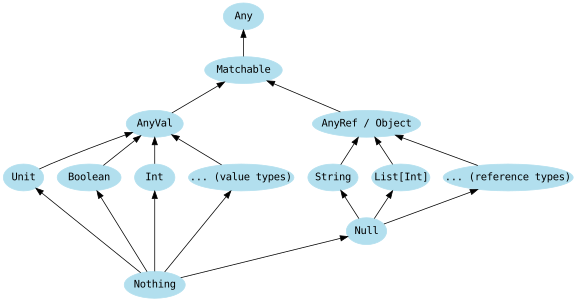
hierarchy Any- The supertype of all types, also called the top type
- It defines certain universal methods such as
equals,hashCode, andtoString
Matchable- Used to mark all types that we can perform pattern matching on
AnyVal- Value types
Byte,Int,Long,Short,Double,Float,Char,Unit,Boolean- Default numeric types:
Int,Double - You can append the characters
L,D, andF(and their lowercase equivalents) to numbers to specify that they areLong,Double, orFloatvalues Unit- A value type which carries no meaningful information
- There is exactly one instance of
Unitwhich we can refer to as:() - If you write methods in Scala that have no return value,
Unitis used for the same purpose asvoid
AnyRef- Reference type
- Correspond to
java.lang.Object
Nothing- A subtype of all types, also called the bottom type
- There is no value that has the type
Nothing - A common use is to signal non-termination, such as a thrown exception, program exit, or an infinite loop—i.e., it is the type of an expression which does not evaluate to a value, or a method that does not return normally
Null- A subtype of all reference types
- It has a single value identified by the keyword literal
null - Currently, the usage of
nullis considered bad practice
String
Similar to Java String
Multiline strings
val quote = """The essence of Scala:
               Fusion of functional and object-oriented
               programming in a typed setting."""
One drawback of this basic approach is that the lines after the first line are indented, and look like this:
"The essence of Scala:
               Fusion of functional and object-oriented
               programming in a typed setting."
When spacing is important, put a
|symbol in front of all lines after the first line, and call thestripMarginmethod after the string:val quote = """The essence of Scala: |Fusion of functional and object-oriented |programming in a typed setting.""".stripMargin"The essence of Scala: Fusion of functional and object-oriented programming in a typed setting."
String Interpolation
String interpolation provides a way to use variables inside strings
The
sInterpolatorPrepending
sto any string literal allows the usage of variables directly in the stringval name = "James" val age = 30 println(s"$name is $age years old") // "James is 30 years old" println(s"2 + 2 = ${2 + 2}") // "2 + 2 = 4" val x = -1 println(s"x.abs = ${x.abs}") // "x.abs = 1" // escape $ "" println(s"New offers starting at $$14.99") // New offers starting at $14.99 println(s"""{"name":"James"}""") // {"name":"James"}
The
fInterpolatorPrepending
fto any string literal allows the creation of simple formatted strings, similar toprintfin other languagesTypesafe
If there is no
%character after a variable definition a formatter of%s(String) is assumedval height = 1.9d val name = "James" println(f"$name%s is $height%2.2f meters tall") // "James is 1.90 meters tall" // escape % println(f"3/19 is less than 20%%") // "3/19 is less than 20%"
The raw Interpolator
The raw interpolator is similar to the
sinterpolator except that it performs no escaping of literals within the stringscala> raw"a\nb" res1: String = a\nb
Custom Interpolators
Control Structures
OOP
// class
case class Student(var rollno : Int = 1, var name : String = "John", var marks : Int = 90) {
  // method
  def show() = {
    println("Hi");
  }

  def >(s : Student) : Boolean = marks > s.marks
}

// objects
val s1 = Student(marks = 80)
val s2 = Student(name = "David")

s1.show()
s1 > s2
Method
Everything is a method (No operators)
1 + 2
// + is actually a method
1.+(2)
foo
List and Lambda Expression
val nums = List(1, 2, 3, 4, 5, 6)
for (n <- nums) println(n)
nums.foreach{ (n : Int) => println(n) }

nums.reverse	// reverse list, return a new list
nums.drop(2).take(2)	// remove first 2 elements, take next 2 elements

nums drop 2	// also valid

nums.head
nums.tail

nums.filter(n => n > 1)

nums.partition(n => n > 2)
// tuple // in scala we can return multiple values val parts = nums.partition(n => n > 2) val p1 = parts._1 val p2 = parts._2 // or val (p1, p2) = nums.partition(n => n > 2)