
Binary Tree Concept & Pattern
🧠 Concept
Tree is a data structure where the data is organized in a hierarchical structure. There should be one root node (which does not have any parent) and all subsequent nodes are represented as children of the root node and its children
If a node has at least one child, it is called internal node and nodes with no children are called leaf nodes
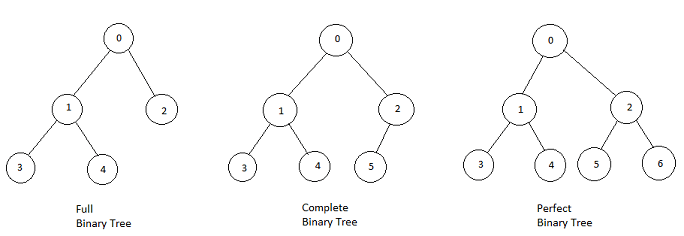
Perfect binary tree: every node except leaf nodes has exactly two child nodes, all leaf nodes are at the same level
Complete binary tree: a binary tree in which every level, except possibly the last, is completely filled, and all nodes in the last level are as far left as possible
Full binary tree: every node except leaf nodes has zero or two child nodes
Balanced Binary Tree: The heights of any node’s left and right subtrees differ by at most one
Implementation
Tree node
Array for complete binary tree
Program stack
Hash table
Traversal
DFS
Three different orders represents three different times when the specific operation is operating on the node
- Pre-order: operates when the procedure call of current node is just pushed onto the stack
- In-order: operates when the left subtree's operation is executed and the right subtree's operation is about to executed
- Post-order: operates when the the procedure call of current node is about to be popped out from the stack
void dfs(TreeNode root) {
    if (root == null) {
        return;
    }
    // preorder
    dfs(root.left);
    // inorder
    dfs(root.right);
    // postorder
}
        1
    2    	3
  4   5   6   7

// Example: 	[1,2,3,4,5,6,7]
// preorder: 	[1,2,4,5,3,6,7]
// inorder:		[4,2,5,1,6,3,7]
// postorder:	[4,5,2,6,7,3,1]
BFS
void bfs(TreeNode root) {
    if (root == null)
        return;

    Deque<TreeNode> q = new ArrayDeque<>();
    q.add(root);
    int depth = 1;
    while (!q.isEmpty()) {
        int sz = q.size();
        for (int i = 0; i < sz; i++) {
            TreeNode cur = q.remove();
            System.out.println("depth = " + depth + ", val = " + cur.val);
            if (cur.left != null)
                q.add(cur.left);
            if (cur.right != null)
                q.add(cur.right);
        }
        depth++;
    }
}
💡 Mindset
遍历
- 递归:DFS
- 层序:BFS
分解子问题(子树)
- 递归 DFS
Coding Style
遍历设置函数名为
traverse/dfs/backtrack,函数不要有返回值,通过外部变量来控制递归的终止分解问题函数有返回值,函数名称有清晰意义
只需要思考一个节点上需要做什么,其他交给递归
递归算法的时间复杂度 = 递归树的节点个数 x 每个节点的时间复杂度
递归算法的空间复杂度 = 递归树的高度 + 算法申请的存储空间
🛠️ Tricks
Morris traversal for inorder
栈模拟递归
class Solution {
    private Stack<TreeNode> stk = new Stack<>();

    public List<Integer> postorderTraversal(TreeNode root) {
        // 记录后序遍历的结果
        List<Integer> postorder = new ArrayList<>();
        TreeNode visited = new TreeNode(-1);

        pushLeftBranch(root);
        while (!stk.isEmpty()) {
            TreeNode p = stk.peek();

            if ((p.left == null || p.left == visited)
            && p.right != visited) {
                pushLeftBranch(p.right);
            }

            if (p.right == null || p.right == visited) {
                // 后序遍历代码位置
                postorder.add(p.val);
                visited = stk.pop();
            }
        }

        return postorder;
    }

    private void pushLeftBranch(TreeNode p) {
        while (p != null) {
            stk.push(p);
            p = p.left;
        }
    }
}