
Graph Concept & Pattern
🧠 Concept
Definition
A graph consists of a collection of objects (vertex) and connections between them (edge)
A superset of non-binary tree
Degree
How many edges does a vertex have
Indegree and outdegree for a directed graph
Simple graph
Graphs without self edges or parallel edges
[Sparse graph -> Dense graph]
Subgraph
Spanning subgraph
- A subgraph which contains all vertices and some edges
Induced subgraph
- A subgraph which contains some vertices and all edges connecting them
Types
Directed graph
Undirected graph
Is technically a dual-directed graph
Weighted graph
Unweighted graph
Cyclic graph
Acyclic graph
Connectivity
Connected graph
- If there is a path between any pair of vertices in an undirected graph, it is a connected graph
Strongly Connected Graph
- If there is a directed path between any pair of vertices in a directed graph, it is a strongly connected graph
Weakly Connected Graph
- If there is a path between any pair of vertices in a directed graph after turning into an undirected graph, it is a weakly connected graph
Connected component
Implementations
Edge list
Adjacent list
- Vertices are stored as records or objects, and every vertex stores a list of adjacent vertices
Adjacent matrix
- A two-dimensional matrix, in which the rows represent source vertices and columns represent destination vertices
- Data on edges and vertices must be stored externally. Only the cost for one edge can be stored between each pair of vertices
Incidence matrix
- A two-dimensional matrix, in which the rows represent the vertices and columns represent the edges
- The entries indicate the incidence relation between the vertex at a row and edge at a column
Examples
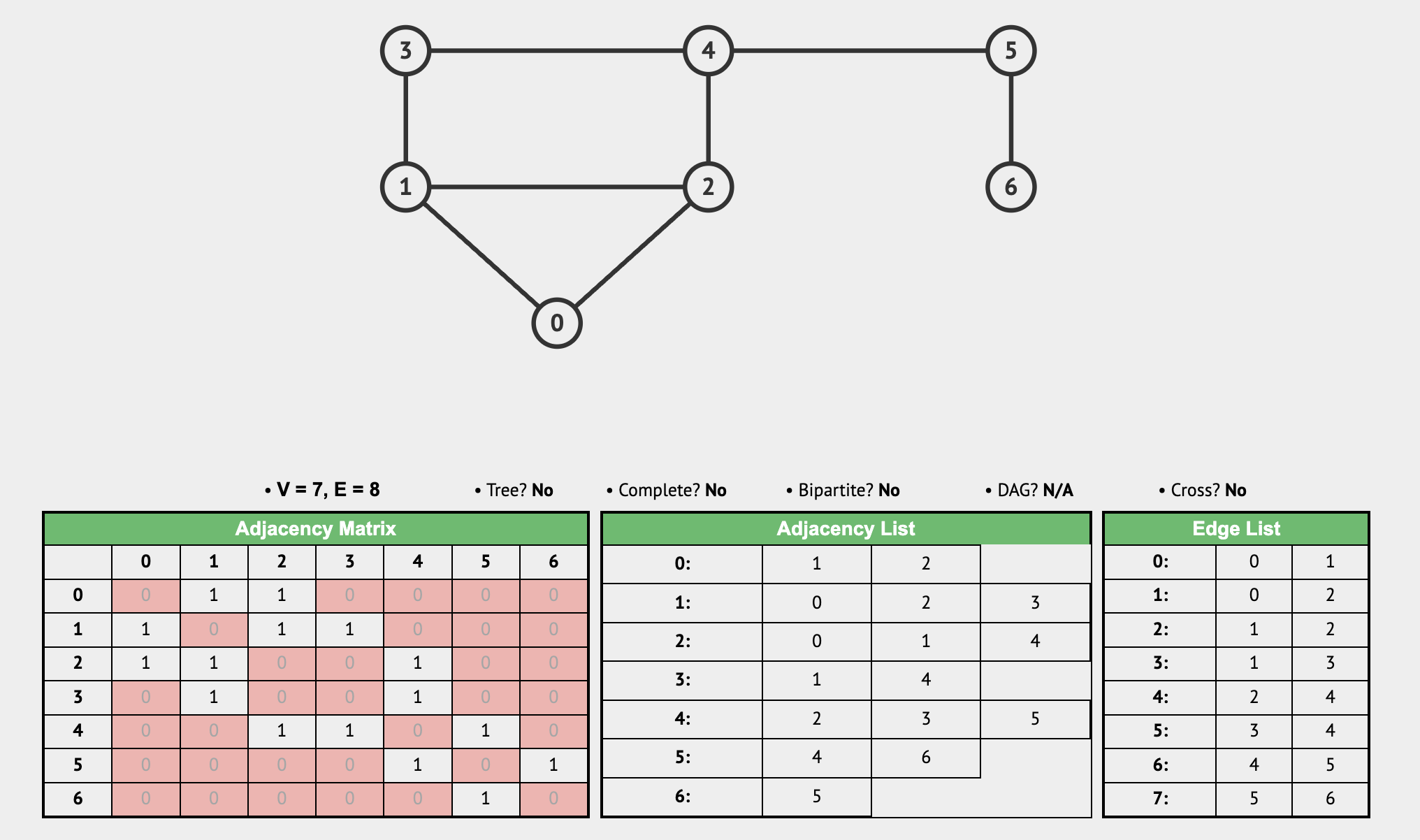
- Undirected and unweighted
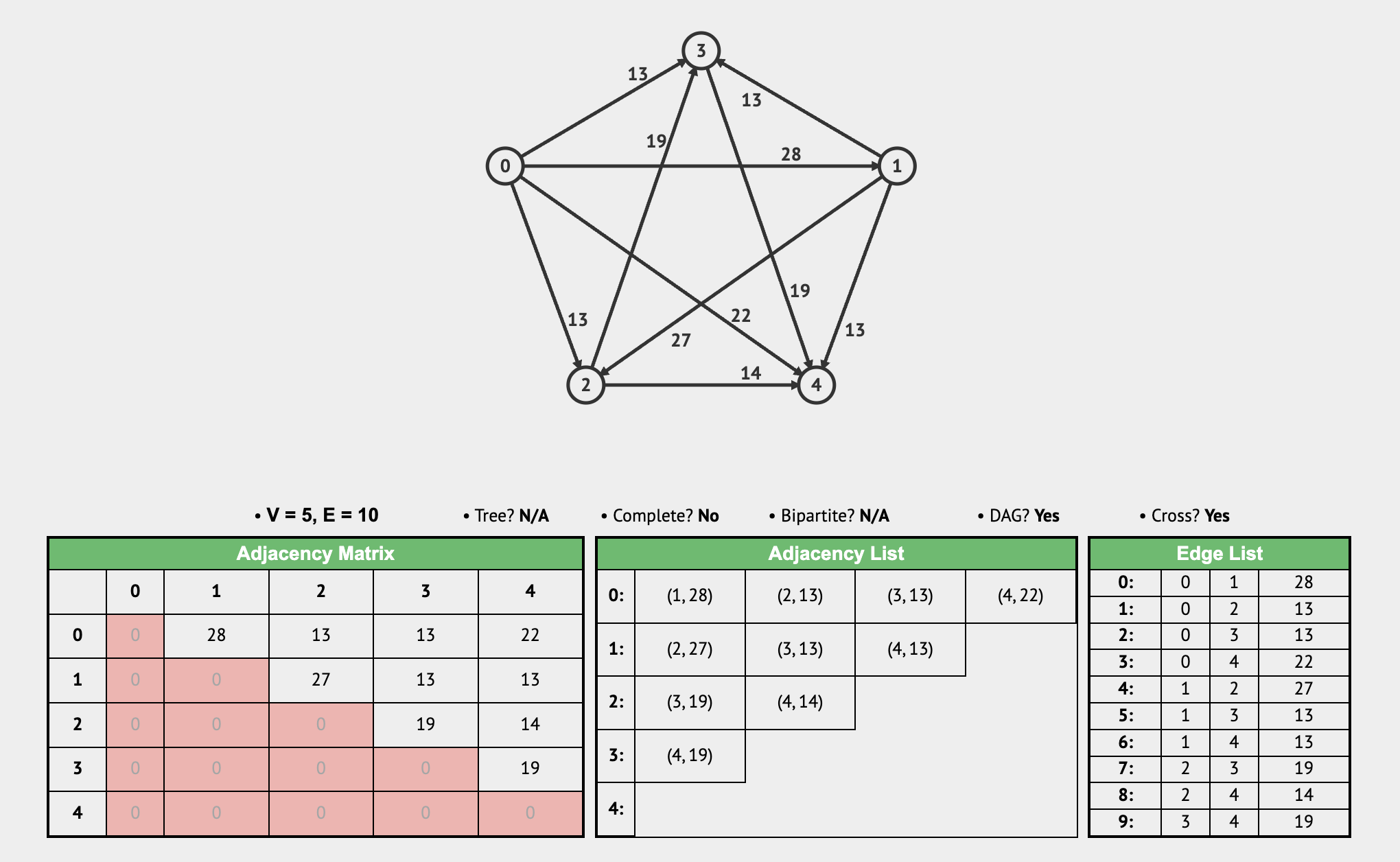
- Directed and weighted
- Undirected and unweighted
Complexity
Adjacency list Adjacency matrix Incidence matrix Store graph Add vertex Add edge Remove vertex Remove edge Are vertices x and y adjacent (assuming that their storage positions are known)? Remarks Slow to remove vertices and edges, because it needs to find all vertices or edges Slow to add or remove vertices, because matrix must be resized/copied Slow to add or remove vertices and edges, because matrix must be resized/copied
Tricks
Adjacency lists are generally preferred for sparse graphs, while an adjacency matrix is preferred for dense graphs.
Adjacency matrix can leverage matrix operations to solve some subtle problems.
The time complexity of operations in the adjacency list representation can be improved by storing the sets of adjacent vertices in more efficient data structures, such as hash tables or balanced BST.
🛠️ Pattern
Tips
Just like tree, think what to do and when to do on a vertex.
Prefer using adjacent list for leetcode problem.
Traversal
Info
In general, DFS finds all paths, BFS finds the shortest path.
DFS
// 遍历所有节点
// O(E + V)

// in case there is a cycle in the graph that causes dead loop
void traverse(Graph graph, int s, boolean[] visited) {
    // base case
    if (s < 0 || s >= graph.size()) {
        return;
    }
    if (visited[s]) {
        // 防止死循环
        return;
    }
    // 前序位置
    visited[s] = true;
    System.out.println("visit " + s);
    for (Edge e : graph.neighbors(s)) {
        traverse(graph, e.to, visited);
    }
    // 后序位置
}
Tips
DFS visits every reachable node and examines every reachable edge, but it only uses a subset of the edges—called DFS tree edges—to discover nodes.
For a connected graph, that subset contains V - 1 edges, even when the graph contains many more than V - 1 edges.
// 遍历所有边
// O(E + V^2)

void traverseEdges(Graph graph, int s, boolean[][] visited) {
    // base case
    if (s < 0 || s >= graph.size()) {
        return;
    }
    for (Edge e : graph.neighbors(s)) {
      // 如果边已经被遍历过,则跳过
      if (visited[s][e.to]) {
        continue;
      }
      // 标记并访问边
      visited[s][e.to] = true;
      System.out.println("visit edge: " + s + " -> " + e.to);
      traverseEdges(graph, e.to, visited);
    }
}
Why do we need DFS all vertices?
Suppose you want to perform an operation on every edge exactly once.
For a directed graph, you can process each edge as it appears using DFS all vertices code.
But for an undirected graph, this processes every edge twice: a -> b, b -> a. To process each undirected edge only once, you need to identify or mark edges.
// 遍历图的所有路径,寻找从 src 到 dest 的所有路径

// onPath 和 path 记录当前递归路径上的节点
boolean[] onPath = new boolean[graph.size()];
List<Integer> path = new LinkedList<>();

void traverse(Graph graph, int src, int dest) {
    // base case
    if (src < 0 || src >= graph.size()) {
        return;
    }
    if (onPath[src]) {
        // 防止死循环(成环)
        return;
    }
    if (src == dest) {
        // 找到目标节点
        System.out.println("find path: " + String.join("->", path) + "->" + dest);
        return;
    }

    // 前序位置
    onPath[src] = true;
    path.add(src);
    for (Edge e : graph.neighbors(src)) {
        traverse(graph, e.to, dest);
    }
    // 后序位置
    path.remove(path.size() - 1);
    onPath[src] = false;
}

// 因为前文遍历节点的代码中,visited 数组的职责是保证每个节点只会被访问一次。
// 而对于图结构来说,要想遍历所有路径,可能会多次访问同一个节点,这是关键的区别。
同时使用
visitedandonPath- 遍历所有路径的算法复杂度较高,大部分情况下我们可能并不需要穷举完所有路径,而是仅需要找到某一条符合条件的路径。这种场景下,我们可能会借助
visited数组进行剪枝,提前排除一些不符合条件的路径,从而降低复杂度。
- 遍历所有路径的算法复杂度较高,大部分情况下我们可能并不需要穷举完所有路径,而是仅需要找到某一条符合条件的路径。这种场景下,我们可能会借助
不使用
visitedandonPath- Acyclic graph
Tips
对于树来说,遍历所有点就是遍历所有边,因为树的每个节点只有一条来自父节点的边(除了 root)。遍历路径思想一样。
BFS
// 从 s 开始 BFS 遍历图的所有节点,且记录遍历的步数
void bfs(Graph graph, int s) {
    boolean[] visited = new boolean[graph.size()];
    Queue<Integer> q = new LinkedList<>();
    q.offer(s);
    visited[s] = true;
    // 记录从 s 开始走到当前节点的步数
    int step = 0;
    while (!q.isEmpty()) {
        int sz = q.size();
        for (int i = 0; i < sz; i++) {
            int cur = q.poll();
            System.out.println("visit " + cur + " at step " + step);
            for (Edge e : graph.neighbors(cur)) {
                if (visited[e.to]) {
                    continue;
                }
                q.offer(e.to);
                visited[e.to] = true;
            }
        }
        step++;
    }
}
Tricks
Optimised BFS: double-way BFS